Deer Park History:


Experience Washington

Information from the tourism division

All About WA State

Useful state facts from Access Washington

State Symbols

Learn about our state symbols here

Timeline Washington

Travel back in time and discover

WA Historical Society

Search for specific events

Genealogy Society

Find your relatives or those you care for

WA State Archives

View school, naturalization, and vital records

Certificate Orders

Birth, death, marriage, and divorce records


"A Brief History of our town: By Maureen Dobson

1889 was an eventful year for our part of the northwest! Washington became a state, the Spokane Falls & Northern Railroad began laying tracks which would eventually reach Canada, and the city of Spokane Falls (later shortened to Spokane) suffered a fire that destroyed 32 city blocks.

It was also the year a young New Yorker named William Hopkins Short came west. Seeing a need, Short started a business supplying raw lumber to the city and the railroad. He and his brother-in-law, George Crawford, rented a portable sawmill set up by a railroad siding about 25 miles north of Spokane Falls. The area was heavily wooded and had an abundance of whitetail deer. Railroad workers had already dubbed the site a veritable "deer park."

The mill’s closest neighbors were homesteaders; farmers and ranchers on nearby Half Moon and Wild Rose prairies. There was no easily accessible school, church, doctor or law enforcement. So, the Short family and their new neighbors went about the business of making a community out of the wilderness. A decade later, the success of their venture was clear.

P.J. Kelly filed a petition for the town site of "Deer Park" in 1899. At the turn of the century the population was 300. The town had three "general merchandise" stores, a blacksmith and harness shop, a livery and feed stable, a hotel, school, doctor, several churches, a post office, and, of course, the lumber mill, which employed 35 men.

The city was incorporated in 1908 with Mayor A.J. Peters as its first elected official. By this time, the population had swelled to 1000. Rural free postal delivery and telephone lines "out to the farmers" had been established. The city had a newspaper, The Deer Park Union (currently named the Tribune), and several proud automobile owners. In 1906, the Arcadia (apple) Orchards Co. began as a venture of East Coast financiers. The orchard once covered land from Loon Lake to Dragoon Creek. Remnants are still visible around Deer Park today.

The 1908 Olson Hotel and 1902 Kelly Mercantile buildings are still in use at the heart of the city’s business district. The first community fair was held in the fall of 1910. The first high school (present location of city hall) was built in 1911. When America declared war against Germany in the spring of 1917, the population of Deer Park was more than 1400, with 250 citizens subscribing to telephone service.

In the years between the two world wars, water meters were installed, sidewalks laid and street name signs put up. 600 people attended the first Tri-County Settlers’ Days celebration held at the Losh farm on Wild Rose Prairie in 1922. "Talking pictures" came to town and a public library opened. Boy Scout and Camp Fire girl troops were organized, as were the VFW, 4-H, Future Farmers of America, Masons and Eastern Star, clubs still going strong.

1936 was noted as a banner year for the Citizens Utilities Co. as more homes applied for electrical hookup. In 1938, Lauer Funeral Home was founded. Today it is the city’s oldest family owned business. During World War II, Deer Park Airport was built as well as the municipal park (later named after long-time mayor James Swinyard). The 26-bed general acute hospital with medical/surgical services and long term care was built in 1956.

Deer Park ended the last century with a population nearing 3000. Four schools now accommodate the growing student body. The history and beautification of our community are overseen by such citizen groups as the Deer Park Arts Commission and the Deer Park Tree Commission. Recent accomplishments include an art gallery featuring the work of local artists and a newly completed $105,000, 80,000 square foot skate park.

Among the city’s largest employers are Deer Park School District, Rosauers Food & Drug, Yoke’s Foods, Evergreen Truss & Supply and Deer Park Hospital. And what of the lumber mill that started it all? Although Will Short sold the business in 1914 to "a couple of college men," "The Mill" continued under various owners for another 56 years.

Street signs, photos and the stories of "old-timers" still stand as testimony to its contribution to the founding of Deer Park. Another Historic to Present View of Deer Park and City Government.

Main Street 1908

Deer Park Main Street 1908

William Short and his brother-in-law George Crawford were among the first pioneers in Deer Park. Short and Crawford established the Standard Lumber Company in 1889. In 1892 a permanent structure was constructed, and the Standard Lumber Company became Deer Park's first major employer. Although Standard changed owners several times, it continually employed a number of Deer Park residents for over eighty years. The company was finally shut down in the mid 1970's.

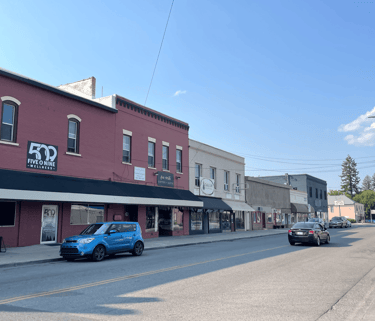
Deer Park's first mercantile store was also established in 1889. The store was owned and operated by P.J. Kelly, who by 1902 had constructed a two-story brick building to house his business. Today, this building is referred to as the Kelly Building, it is located at the corner of Main and Crawford Streets in downtown Deer Park. Residents in the early 1900's witnessed a dynamic period of expansion in Deer Park. Several drug stores, harness and saddle shop were established during this time. A community newspaper, "The Tribune", also commenced operation at this time and is still in publication today.

In 1904, E.N. Robinson opened the Arcadia Apple Orchards Company. Robinson offered the public an investment opportunity that allowed a private investor to obtain five or more acres of prime orchards. The company prospered, and by 1920 Arcadia Orchards was the largest privately owned Orchard Company in the world, encompassing over 20,000 acres. Eighteen miles of flumes were built to pump water from Loon and Deer Lakes twelve miles from the City center. The lakes, however, became dangerously low, and in 1922 the company was forced to close. The Orchard Warehouse building is currently owned by the City and leased to the Deer Park Fair and Rodeo Association.

Since that time, Deer Park has remained a residential, farming and timber community. Many tourists pass through en-route to the many lakes and snow skiing areas situated nearby. The community plays host to several events during the year, the Deer Park Winter Festival in January, Deer Park Community Flea Market is the last Saturday in June, Settlers Day the fourth full weekend in July (Washington States oldest festival), Deer Park Rodeo, Deer Park Fair and Junior Rodeo.

The City hosts a holiday tree lighting celebration the first Monday following Thanksgiving to kick off the holiday season. There are horse drawn sleigh rides, a live nativity scene, holiday music entertainers, Art show, a visit from Santa, and treats for all. Santa's has a workshop just outside the City limits and is open December 15th through 24th.

There are seven fresh-water lakes within a radius of 20 miles, each offering swimming, fishing, and boating. The area is highly populated with wildlife that makes it very appealing to even the most avid sports enthusiast. City owned swimming pool and School District's tennis courts are popular recreational spots. Deer Park Golf and Country Club has an eighteen-hole course. There are two winter ski areas nearby and a horseback riding stable is within ten miles of downtown Deer Park. The City owns and maintains a cross-country ski trail that is located at the Municipal Airport. The Deer Park pool was constructed in 1948 with the addition of the pool house in May 1952. It is the only public swimming facility within a twenty-mile radius of Deer Park.

The City has a strong Mayor-Council form of government, organized under the Optional Municipal Code as provided in State Law. The independently elected Mayor is responsible for all administrative functions of the City and all Department Supervisors report to the Mayor. Mayor Wolfe's term runs through December 31, 2001. The Mayor presides over the City Council meetings as provided by state law. However, he is not a member of the legislative body. An official record of the Council meeting is recorded by the City Clerk-Treasurer and is a public record.

The five City Council members exercise legislative and quasi-judicial functions. It is the duties of this body to gather information, review, and make decisions regarding official City policies and laws. Regular meetings are held twice monthly at 7:00 p.m., on the first and third Wednesdays, at City Hall. The Council assesses utility rates, licenses and permit fees, lease rates, ad valorem taxes, employees salaries, employee training and benefit programs, and elected officials' stipends (for the next term of office following the current Council members terms). They adopt the annual budget, fix the compensation and working conditions of its officers and employees. The Council approves the expenditures of the City, signs the monthly accounts payable approval form, and authorizes the annual budget. Final decisions on zoning, variances, and conditional use permits are the responsibility of the City Council. All contractual agreements are entered into by a vote of the Council. Each Council member receives a monthly compensation of one hundred dollars.

Business District 1893

Deer Park Business District

The City's investment dollars are monitored by the City Treasurer with the assistance of the Accounting Clerk. Currently the City is investing with the Washington State Investment Pool. The City's investment policy received the Certification of Excellence award on April 8, 1994 from the Washington Municipal Treasurers Association. This award of excellence accents the City's financial credibility and bond rating.

The City Municipal building was constructed in 1912 by the Deer Park School District and used as a high school. The City acquired this property in 1978. The Deer Park Municipal Airport is one of the finest small airports in the West. The airport occupies 1,640 acres in the northeast part of the City and has a field elevation of 2,207 feet. The United States Army and the Town of Deer Park began the planning and construction of the airport in March 1941. In 1943, federal funds in the amount of $843,361 were allocated for airport development. The City purchased forty acres of land in accordance with the Army's plan for the airport.

The Deer Park Municipal Airport runway construction started in 1943. In 1944, an aircraft hangar measuring 60 feet by 60 feet was built by the City. In the mid-to-late 1950's, virtually no aviation activity occurred at the airport. In the mid-1960's, some airplanes were based there and aviation activity began to increase. The primary runway 16-34 was partially reconstructed in 1976. The two active runways are 6100 foot long and have radio operated landing lights. The load bearing strength of runways 16-34 and 4-22 is 13,500 pounds single wheel. The Deer Park Municipal Airport's 640 acres were annexed into the City of Deer Park in April of 1982.

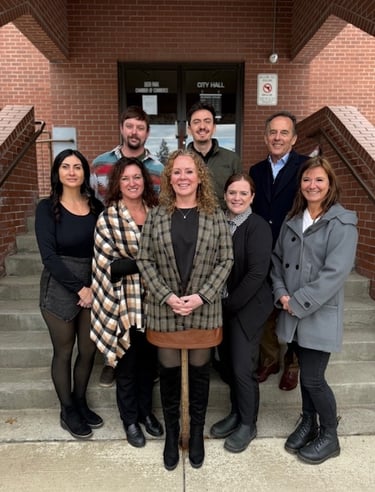
The municipal building is open to the public for viewing of Deer Park High School graduation pictures from the classes of 1913 through 1958. The City's offices along with Deer Park Senior Center, Arts Commission, SCOPE & Sheriff's substation, and the Deer Park Chamber of Commerce are located in the municipal building.

The Municipal Court System is currently contracting Spokane County Judge Sara Derr to oversee the court cases on a semi-monthly schedule. The Court system hears traffic, criminal traffic, and non-criminal traffic cases on the second and fourth Tuesday's at 5:00 p.m. in the City Hall Council Chambers. All violations are received from Spokane County Sheriff Department and thoroughly processed through the City's Court Department. Spokane County Sheriff Department is contracted by the City of Deer Park to provide twenty-four hour protection for the City.

In December 1993 the City entered into a joint action agreement with Spokane County Fire District #4. At that time Fire District #4 purchased the City's fire equipment including fire trucks, breathing apparatus, radio pager, coats and pants, fire helmets and fire boots. Fire District #4 is leasing the City's fire station This contract provides recruiting, training, and retention programs for the fire fighters. The contract also provides inspections and coordination of all pertinent Fire Department functions, which includes coordination of a twenty-four hour dispatch service.

A joint effort between the City and Spokane County Library District provides complete library services for the citizens. Among these services the citizens may obtain periodicals, records, compact discs, cassette tapes and reference services, inter-library loans, and community referral services, special children's programs, including summer reading program, story hour sessions, puppet shows, and filmstrips.

Summary

Deer Park took its roots in 1889 when William H. Short and George Crawford set up a portable sawmill in a thickly timbered area north of Spokane. The Deer park Mill would exist for 81 years, with its first permanent structure erected in 1892.

Click Here to read more about the history of Deer Park by Nancy Fisher.